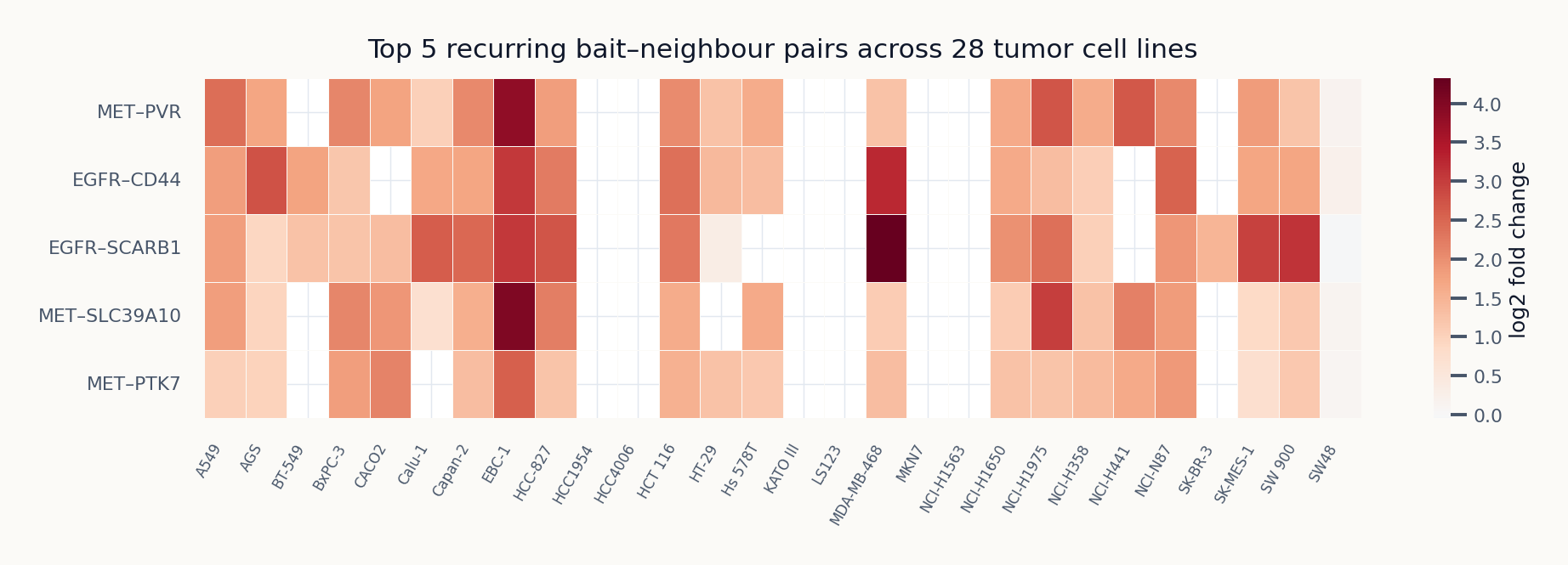
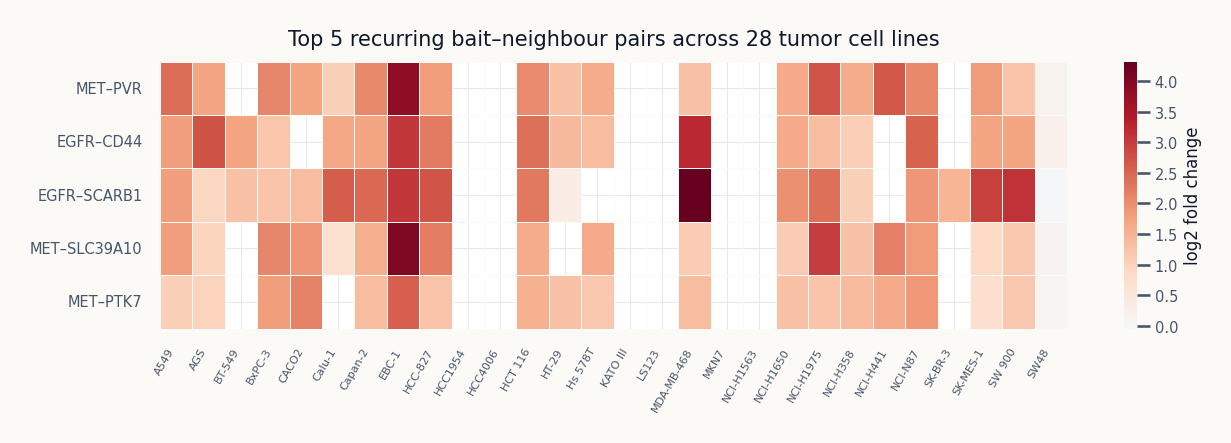
Here's what the analysis found. Across InduPro's proximity atlas, the neighbour that recurs in the most tumor cell lines next to a receptor tyrosine kinase bait is PVR/CD155 near MET (19 of 28 lines), followed by CD44 near EGFR and SCARB1 near EGFR (18 lines each). For the top three pairs, I found no bispecific antibody or deliberate combination that targets that exact pair in ClinicalTrials.gov or the literature I searched — co-targeting programs pair these baits with other partners (PD-1, HER3, VEGF, MUC1, CEACAM6, TROP2), not with each other.
The dataset
Zenodo record 21678744 DOI 10.1038/s41586-026-11003-7 is the open data behind InduPro's Nature paper, "Proximity-Guided Graph Learning Reveals Tumor-Associated Proximity Antigens" (doi:10.1038/s41586-026-11003-7). The measurements table, tapas_manuscript_proximity_data.csv, has 807,726 rows. Each row is a bait protein, a proximal ("neighbour") protein, a cell line, a log2 fold change and a −log10 p-value from a proximity-labelling map. I confirmed the structure directly:
- 12 baits, all receptor tyrosine kinases: AXL, DDR1, EGFR, EPHA2, ERBB2, ERBB3, FGFR2, IGF1R, MET, PDGFRB, PTK7, ROR1.
- 28 tumor cell lines: A549, AGS, BT-549, BxPC-3, CACO2, Calu-1, Capan-2, EBC-1, HCC-827, HCC1954, HCC4006, HCT 116, HT-29, Hs 578T, KATO III, LS123, MDA-MB-468, MKN7, NCI-H1563, NCI-H1650, NCI-H1975, NCI-H358, NCI-H441, NCI-N87, SK-BR-3, SK-MES-1, SW 900, SW48.
Row count and both category counts match the paper's description (12 baits × 28 lines).
The method, in plain words
-
What counts as a neighbour. I used the authors' own hit rule from their released code (Zenodo record 21679069, Apache 2.0): a partner is a hit in a cell line when log2 fold change ≥ 1 and p ≤ 0.05 (i.e. −log10 p ≥ 1.30103). That is their definition, not one I invented. Applying it leaves 23,089 hit rows of 807,726 (computed by counting rows where log2_fc ≥ 1 and nlog10_pvalue ≥ −log10(0.05); inputs: total rows 807,726 from the Zenodo table, filter from the authors' released rule).
-
Keep only cell-surface partners. Enrichment near a surface RTK will pick up plenty of cytoplasmic and secreted proteins that are not druggable surface antigens. I pulled the 2,649 distinct partner accessions from the hit set and queried UniProt REST in batches of 100 (30-second timeout, up to 3 retries), asking for accession, keyword, cc_subcellular_location. All 27 batches succeeded, 0 failed, annotating all 2,649 accessions. I flagged a partner as surface if it carries keyword "Cell membrane" (KW-1003) or a subcellular-location string containing "Cell membrane" or "Plasma membrane". That marked 982 of 2,649 accessions as surface and left 13,757 surface hit rows.
-
Drop self-pairs and rank. After removing rows where the bait is its own partner (207 rows), 13,550 surface hit rows remain. I ranked bait–partner pairs by the number of distinct cell lines in which they pass, using mean log2 fold change as the tiebreaker, and expressed the mean fold change as a plain multiplier (2^mean log2FC).
Top 15 recurring surface bait–neighbour pairs
Ranked by cell-line count, mean log2FC as tiebreak (13,550 surface, self-pair-dropped hit rows; ranking rule as above):
| Rank | Bait | Neighbour | Cell lines (of 28) | Mean log2FC | Fold (×) | Note |
|---|
| 1 | MET | PVR (CD155) | 19 | 2.08 | 4.2 | surface (nectin-like) |
| 2 | EGFR | CD44 | 18 | 2.84 | 7.2 | surface |
| 3 | EGFR | SCARB1 | 18 | 2.32 | 5.0 | surface (SR-BI); very abundant, "sticky" (see caveats) |
| 4 | MET | SLC39A10 | 18 | 2.07 | 4.2 | surface (zinc transporter) |
| 5 | MET | PTK7 | 18 | 1.92 | 3.8 | surface RTK-like |
| 6 | MET | CD44 | 17 | 2.73 | 6.7 | surface |
| 7 | MET | CBL | 17 | 2.64 | 6.2 | technicality — see below |
| 8 | MET | PRNP | 17 | 2.46 | 5.5 | GPI-anchored surface |
| 9 | EGFR | ALCAM | 17 | 2.44 | 5.4 | surface |
| 10 | MET | ALCAM | 17 | 2.41 | 5.3 | surface |
| 11 | MET | IGKV2-40 | 17 | 2.22 | 4.7 | technicality — see below |
| 12 | MET | TFRC | 17 | 2.13 | 4.4 | surface (transferrin receptor); abundant |
| 13 | MET | EPHB2 | 17 | 2.00 | 4.0 | surface RTK |
| 14 | MET | ITGB1 | 17 | 1.91 | 3.8 | surface integrin; abundant/promiscuous |
| 15 | EGFR | ITGAV | 17 | 1.88 | 3.7 | surface integrin |
The recurrence bar chart ("Cell-line recurrence of top 15 surface bait–neighbour pairs") and the heatmap ("Top 5 pairs × 28 cell lines, coloured by log2 fold change") show the pattern: MET dominates the recurring list, and the leading pairs are enriched across most — but not all — of the 28 lines.
Entries that clear the surface filter on a technicality
Two entries pass the keyword filter but are not what the filter is meant to capture:
- MET–CBL (rank 7). CBL is an E3 ubiquitin ligase that acts at the cytoplasmic face of the membrane on activated RTKs; it is recruited to MET as part of receptor down-regulation. UniProt tags it "Cell membrane" because it is peripherally membrane-associated, but it is not a surface-exposed antigen and cannot be bound by an extracellular antibody arm. Its recurrence is real biology (MET signalling), but it should be excluded from any surface-antigen shortlist.
- MET–IGKV2-40 (rank 11). This is an immunoglobulin kappa variable gene segment. Such hits are proteomic artifacts / annotation quirks rather than a bona fide surface partner of MET, and the "Cell membrane" tag rides along on immunoglobulin annotation. Discard it.
A few others are technically surface but deserve suspicion as abundance-driven neighbours rather than specific partners: SCARB1, TFRC, ITGB1 are highly expressed, promiscuous membrane proteins that tend to appear near many baits (see caveats).
Are the top three already targeted together by a bispecific?
I searched only the top three pairs — MET–PVR, EGFR–CD44, and EGFR–SCARB1 — in ClinicalTrials.gov and the literature. For each, I looked for a bispecific antibody or a deliberate combination hitting that exact pair.
1. MET–PVR/CD155 — none found. No ClinicalTrials.gov record and no paper describing a MET × PVR (CD155) bispecific or deliberate combination surfaced. MET is heavily co-targeted, but always with other partners: PD-1 PUBMED 29046141, HER3 DOI 10.1158/1538-7445.am2023-lb212 DOI 10.1158/1538-7445.am2024-2617 DOI 10.1158/1538-7445.am2026-2665, 5T4 DOI 10.1158/1538-7445.am2023-lb213, EGFR DOI 10.1200/jco.2025.43.16_suppl.e15010, and EGFR + VEGF DOI 10.1158/1538-7445.am2023-4494 (these are the target-pair claims; I did not verify each molecule's engineering/DAR details). CD155 itself is an active immuno-oncology target, but via the TIGIT/DNAM-1 axis, not paired with MET. So this is the most striking result: the single most recurrent surface pair in the atlas is not an existing bispecific.
2. EGFR–CD44 — none found as a bispecific. No EGFR × CD44 bispecific antibody or registered combination appeared. EGFR co-targeting bispecifics exist against CD70 DOI 10.1158/1538-7445.am2024-2724, HER2 DOI 10.64898/2025.12.25.696462, CEACAM6 DOI 10.1158/1538-7445.am2026-5388, PD-1 PUBMED 33129108, MUC1 DOI 10.1158/1538-7445.am2023-6325, and MET DOI 10.1200/jco.2025.43.16_suppl.e15010 — but not CD44. (CD44 and EGFR co-signalling is well described biologically; it has not become an antibody pairing that I could find.)
3. EGFR–SCARB1 — none found. No EGFR × SCARB1 (SR-BI) bispecific or deliberate combination surfaced in either source. This pair is also the one I would trust least (SCARB1 is a very abundant lipoprotein receptor — see caveats), so its absence from the pipeline is unsurprising.
Evidence-quality note on this search: most co-targeting hits above are AACR/ASCO conference abstracts (non-peer-reviewed), which frequently omit exact target-pair detail. My "no exact-pair bispecific found" conclusion is therefore best read as "none disclosed in the trial registry or literature I searched," not proof of absence. I did not search patent databases or company pipeline disclosures, where new bispecific target pairs often appear first — so a negative here can be a false negative. General reviews confirm the broader landscape is large (hundreds of dual-TAA bispecifics in development) but I saw none for these three specific pairs PUBMED 32989604 PUBMED 41388342 (landscape context; specific market/count figures in those abstracts not independently verified).
Caveats that matter
- Proximity is not binding. A high log2 fold change means the neighbour was labelled near the bait, not that the two physically interact or that one antibody arm engaging both is therapeutically coherent. Every pair above is a hypothesis, not a validated dual target.
- Cell lines are not tumors. 28 immortalized lines under culture do not reproduce a patient tumor's microenvironment, stroma, or antigen expression. Recurrence across lines is suggestive, not clinical.
- Uncorrected p-values, compounded by recurrence. The authors' hit rule applies p ≤ 0.05 per map with no multiple-testing correction (this is how their released code defines a hit). Ranking by recurrence across 28 lines amplifies this: an abundant, sticky protein will clear an uncorrected threshold in many lines and rise to the top because it is abundant, not because it is a specific MET or EGFR partner. SCARB1, TFRC, ITGB1 and integrins generally are the usual suspects. I did not apply abundance normalization, so treat the recurrence metric as abundance-confounded; the atlas ships a companion
cell_line_protein_intensities.csv that could be used to control for this.
- The surface filter is annotation-based. It admits peripherally-associated proteins (CBL) and annotation artifacts (immunoglobulin gene segments), which is why the technicality call-outs matter. A curated surfaceome list would be stricter.
Sources
- InduPro proximity atlas dataset — Zenodo record 21678744; 807,726 rows, 12 RTK baits, 28 tumor cell lines.
- Authors' analysis code (hit rule log2FC ≥ 1, p ≤ 0.05) — Zenodo record 21679069, Apache 2.0.
- Nature paper — doi:10.1038/s41586-026-11003-7 DOI 10.1038/s41586-026-11003-7.
- UniProt REST (subcellular location / keyword annotation) — 27/27 batches succeeded, 982/2,649 accessions flagged surface.
- Bispecific / combination searches: ClinicalTrials.gov (returned no matches for these exact pairs) and the literature records cited inline above.
This is a computational reanalysis for research context, not therapeutic advice; any pair worth pursuing needs orthogonal interaction validation, abundance control, and expression confirmation in primary tumor tissue.
If useful next, I can: re-rank using the companion intensity file to down-weight abundance artifacts; apply a curated surfaceome instead of the keyword filter; or extend the bispecific search to patents and company pipelines for the top pairs.